
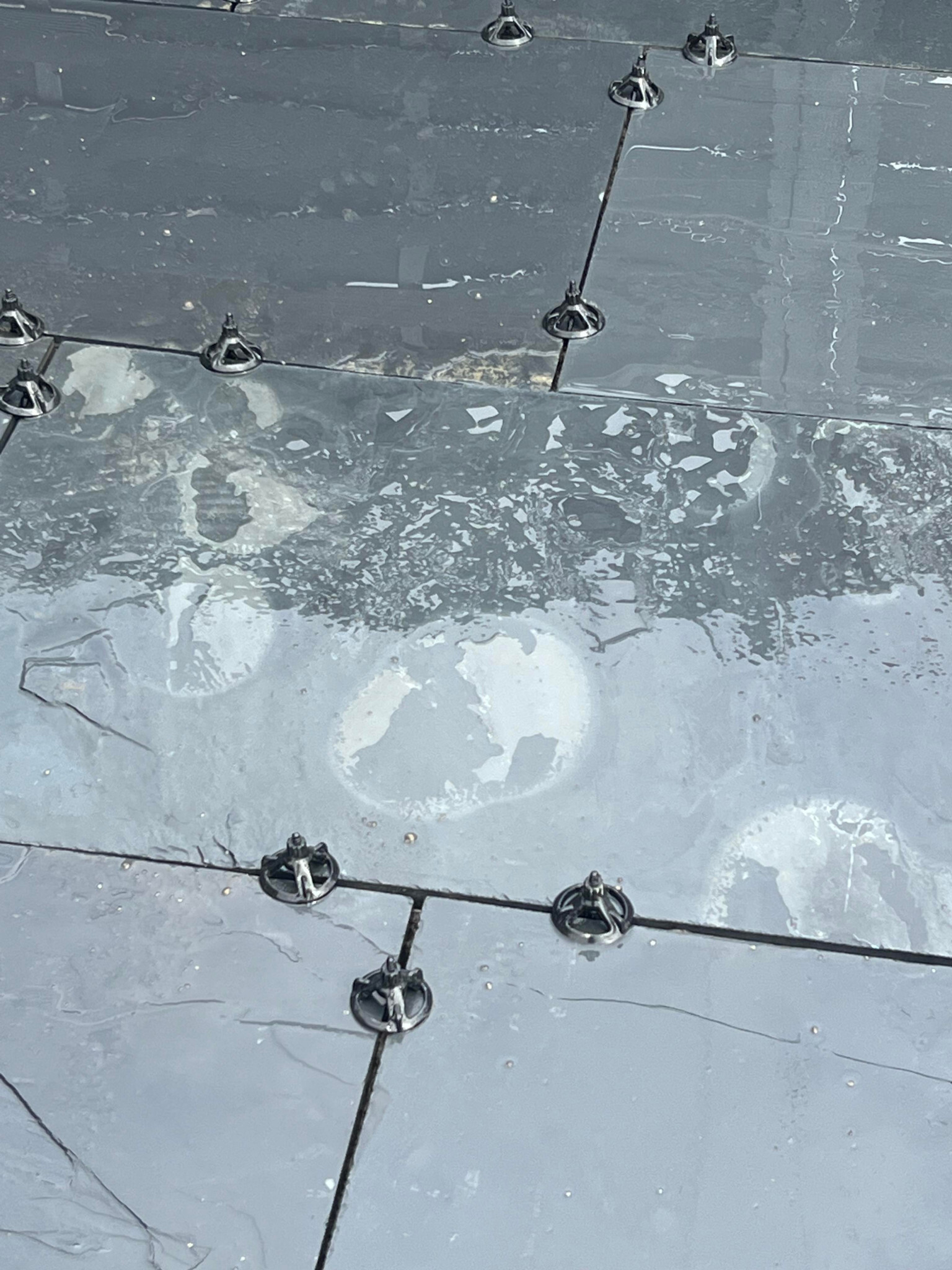
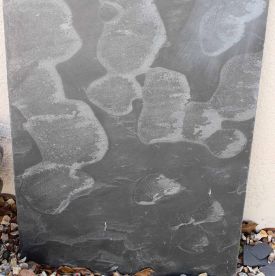
White markings or blemishes in slate are common and are, in fact, hundreds of millions of years old. Rather than being a defect, they are a natural characteristic of the stone and are normally only visible after the slate has been split. However, because they contrast so much with slate’s dark colouring, they’re not always appealing – but, with the correct product, they can be removed without damaging the slate.
What is slate?
Slate is compacted mud and silt, from ancient oceans and river beds, that’s been subjected to pressure in a hot environment, deep underground. Eventually, it is forced to the surface by the collision of continents. Dead creatures, older limestone rocks and marble pebbles that have settled on river or sea beds are crushed between the layers of silt and over millions of years harden to form a calciferous deposit and the tell-tale white marking.
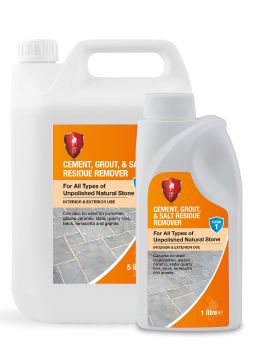
To safely remove the markings, we recommend application of LTP Cement, Grout & Salt Residue Remover after installation and before sealing and grouting. A rapid-cleaning agent, the Remover is non-corrosive and has an acid-replacement formulation, so it’s safe to use on all types of unpolished natural stone. Once in contact with the calcium carbonate deposits, they start to dissolve. The surface is then agitated, residue extracted/removed and the slate is rinsed with clean water. Here are the step-by-step instructions which include more detail:
How to apply LTP Cement, Grout & Salt Residue Remover:
- Shake container well before use. Gloves should be worn and instructions carefully followed. Please refer to the Technical Data Sheet on the product page.
- Apply undiluted solution to the surface of the stone and agitate immediately with an emulsifying pad.
- Rinse thoroughly with clean, fresh water.
- Extract the released calcium deposits with a sponge, rinse with water and leave to dry.
- Repeat the process until the lighter marks have been removed.
N.B. Always dilute by adding product to water, rather than water to product – and always rinse surfaces thoroughly with cool, clean water. When treating vertical surfaces, start at the top and work down.
Other causes of white marks
Efflorescent and rising salts can also cause white marks. This is a slightly different issue which can also be treated with LTP Cement, Grout & Salt Residue Remover, although the application method is different and the treatment and the remover is generally diluted before application. Before treating the slate, it is important to establish whether the markings are calciferous deposits or salt-based.
Protecting slate after treatment
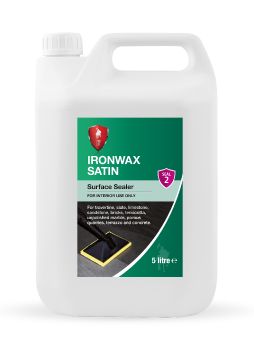
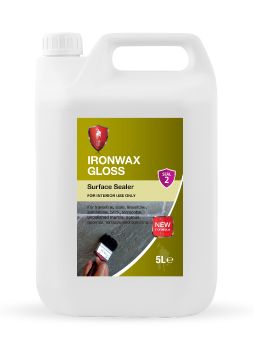
Once the surface is dry, seal the slate to protect it from staining and to repel water, oil and grease. There are lots of different options which can be used to enhance appearance or create a natural finish; wax finishes are popular because they replace the slate’s naturally dusty appearance with a sheen. Our range includes two wax treatments which protect internal installations against staining and dirt: LTP Ironwax Satin and LTP Ironwax Gloss. The waxes are applied onto clean tiles in thin even coats until the desired finish is achieved, to a maximum of six coats. Both are self-shine finishes, so no buffing is needed. They’re ideal for areas with lots of foot traffic and where there’s a risk of oil spillage, like kitchens and dining rooms, but aren’t recommended for wet rooms and shower enclosures (Interior use only). The sheen that they create also makes ongoing maintenance easier.
For a more natural look – and for external slate – we recommend LTP Mattstone H2O or Colour Intensifier & Stainblock H2O. Both are water-based impregnators and, like the waxes, strongly repel water, oil and grease. Whilst both enhance colour tone, we describe Mattstone as creating a finish that looks like the ‘dry end of the beach’ and Colour Intensifier & Stainblock as the ‘damp end of the beach.’
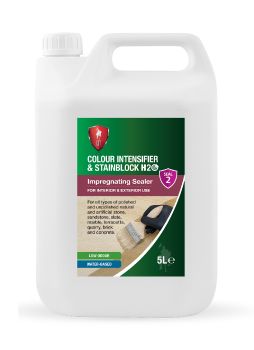
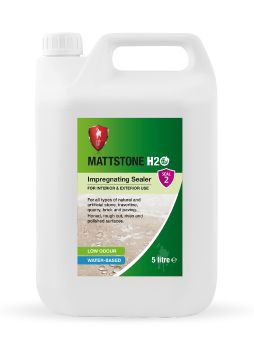
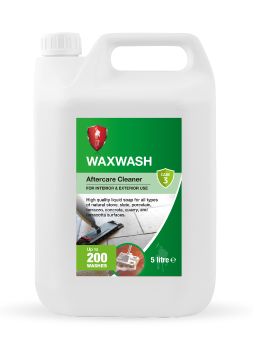
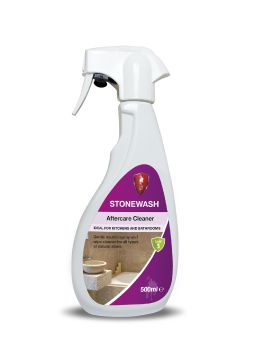
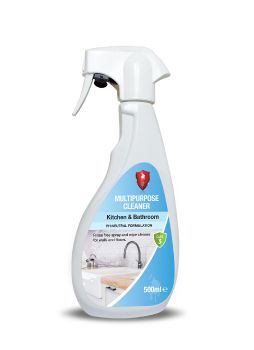
The impregnators can be applied in a single thin layer or multiple thin layers, for stronger colour enhancement. For ongoing maintenance, we recommend our LTP Waxwash for floors and Stonewash or Multipurpose Cleaner for walls internally to protect the stone and the protection applied.
For more information, contact the LTP team on tel. 01823 666213 and email [email protected]. Also, for online help on-the-go, visit LTP TV on YouTube and Product Selector at https://ltp-productguide.co.uk


