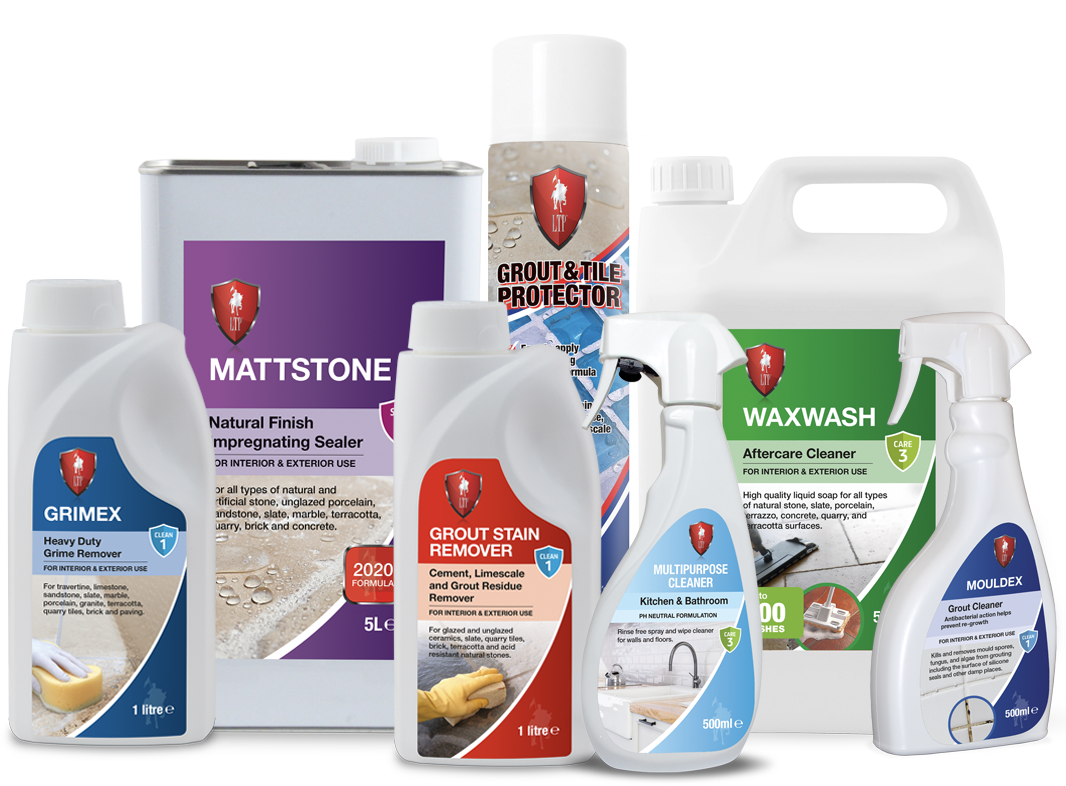
Do you need to clean, seal or maintain your floor and wall tiles?
From the images provided identify your surface type.
Click through to select required cleaning, sealing and maintenance products for your surface.
The LTP range of cleaners, sealers and maintenance products is easy to understand, ideal for both retail and professional customers and can be used on walls and floors, both internally and externally.
STEP ONE: Identify your surface. Click image for choice of sealers
Travertine
A brown, beige or grey dense and holey stone harder than limestone or marble. Sometimes filled with a resin to fill the open voids on its surface prior to honing.
Porosity Test: Up to 15 minutes.
Limestone and Flagstones
New and old limestone and flagstones show great variation in porosity (such porosity sometimes varies within a single tile). ‘Flags’ are generally large, thick, irregular and rectangular. Limestone tiles tend to be more modular and more refined in appearance. Colours range from beige, white, grey, brown and black. Limestone from Europe, India and the Far East are normally thinner and more regular in size. English Limestones such as Purbeck Stone, Hamstone, Bathstone, Stamford Stone, Lincolnshire Stone and Cotswold Limestone are normally thicker and in some cases vary in thickness from piece to piece.
Porosity Test: May vary between 1 minute and 1 hour.
Sandstone
Normally has a rough riven textured surface. However some Indian Sandstone is sawn and honed, so are smooth on the surface. Although harder than limestone, it has a similar absorbency. Colour ranges from red, beige, brown, green to grey. Well known sandstones include Yorkstone, Fossil Stone, Raj Green and Rainbow.
Porosity Test: May vary between 1 minute and 1 hour.
Tumbled and Unpolished Marble
Normally smaller in size ranging from small mosaic to 30 x 30cm tiles and tumbled to give a more rounded worn appearance. Colours range from red, green, brown, beige, black, white, yellow and grey. Smaller mosaic pieces are commonly used to create a decorative border between glazed ceramic tiles.
Porosity Test: Up to 15 minutes.
Riven or Honed Slate
Lower absorbency slate is a very dense compact material and tends to have a fairly smooth regular surface. Common examples include slates from Brazil, China, Wales and Portugal which normally have a natural riven surface, but are sometimes mechanically honed to make them smooth.
Higher absorbency slate is far less dense; a softer, friable and more absorbent material. The surface of higher absorbency slate tends to be more laminated and irregular. Common examples include slates from India and Cornwall.
Porosity Test: Lower absorbency - up to 1 hour; Higher absorbency - up to 15 minutes.
Polished Porcelain
A very hard full bodied man made tile that is available in a variety of colours and is mechanically polished to create a highly polished surface. The polishing process in most cases opens up micro-pores on the surface making the tile susceptible to staining. It is advisable to establish the general absorbency before sealing. This will normally vary according to the origin of the tile and where it has been manufactured.
Porosity Test: Up to 2 hours.
Polished Granite, Marble and Limestone
This is normally very smooth and although mechanically polished it is
susceptible to staining. Most polished stones react detrimentally to acid based substances such as lemon, vinegar or wine. This type of stone is found in a variety of colours and is particularly recognisable for its shiny appearance.
Porosity Test: Up to 30 minutes.
Low Porosity Terracotta and Porous Quarry Tiles
Minimal absorbency, highly vitrified, machine made tiles which are either dust pressed or extruded. They have a resilient hard surface which is difficult to scratch. Available in a variety of colours which range from browns, blacks and reds to creams and blues. Quarry tiles should not be confused with ‘Encaustic’ tiles which are extremely absorbent.
Porosity Test: May vary between 15 minutes and 1 hour.
Encaustic Tiles
Encaustics, made from natural stone and strengthened with crushed marble, are generally brightly coloured, plain or patterned tiles. The pigments, natural oxides, are applied whilst the clay mixture is still in a semi-liquid state and harden into the tile surface. To the untrained eye Encaustics may appear similar to quarry tiles but their variation in porosity is distinctive; unlike quarry tiles, liquids are quickly absorbed into unsealed Encaustic tiles and without protection will easily stain.
Porosity Test: Up to 5 minutes.
Medium and High Porosity Terracotta
Machine made terracotta is generally smooth in appearance with regular edges. Handmade terracotta normally has a rougher texture which is sometimes pitted, may be friable, imprecise in shape with edges that are distorted or frayed. Terracotta will readily scratch and stain when unsealed.
Porosity Test: Up to 5 minutes. (Note: Reclaimed and old terracotta which may appear similar to high porosity terracotta will sometimes not properly absorb sealers. See `Useful Information` page for further details.)
Glazed Ceramic and Glazed Porcelain
Normally fully vitrified with no absorbency because of the glaze. Available in a variety of colours and in some cases manufactured to mimic the appearance of natural stone or terracotta, so should not be confused with a natural material. If in doubt do a quick test to establish your material type. Does not normally require sealing and is easy to maintain. For matt and textured glazes it is possible to coat the surface with LTP Glaze Protector which will give the surface the appearance of a ‘just washed floor’ and help with anti slip.
Porosity Test: Non absorbent.
Grouting
Most grouting is water resistant and not water proof and so absorbs moisture. It is normally moisture carrying dirt particles that discolour grout. Sealing grout joints helps to prevent moisture penetration and prevent dirt particles from being carried into the grout. This means that when washing tiled surfaces dirt is washed away from the grout joint rather than straight into it.
Porosity Test: Up to 5 minutes.
Terrazzo
This like marble is extremely porous, readily stains and reacts detrimentally to acids. It is made from pulverised and chipped marble which are bound together and finished by polishing. It is distinguished from marble by its more crystalline and granular structure, but should still be sealed in the same manner as marble.
Porosity Test: Up to 30 minutes.
Unglazed Porcelain and Vitrified Quarries
A minimal absorbency machine made highly vitrified material with a resilient hard surface that is difficult to scratch. Available in a variety of colours and different textures. The absorbency will vary and normally depends upon the origin of the tile and how well it has been manufactured.
Porosity Test: Over 1 hour.
Worktops
Granite Worktops and other polished natural and artificial stone surfaces.
Porosity Test:
Stone Fireplaces
Stone Fireplaces and other unpolished natural and artficial stone surfaces
Porosity Test:
SEARCH
SHOPPING BASKET
BUY ON LINE
LTP
Tone Industrial Estate
Milverton Road, Wellington, Somerset, TA21 0AN
T +44 (0)1823 666213
F +44 (0)1823 665685
E info@ltp-online.co.uk